 KevinTest
 Is that a tip you are paying or is that a bribe?
Too few people see the relationship between tipping and bribing and even fewer understand the difference. Consider this: Research has shown that in places where people tip heavily, bribes are more likely to exchange hands as well. In addition, Countries with higher rates of tipping behavior also tended to have higher rates of corruption.
New research shows that there’s actually a line between the socially acceptable act of tipping and the immoral act of bribing, according to Magnus Thor Torfason, an assistant professor in Harvard Business School’s Entrepreneurial Management Unit. Professor Torfaon’s basic thesis is “It is generally considered a good-natured pro-social thing to tip, but bribing is considered to be antisocial and negative,” Torfason says. “So this relationship between tipping and corruption is counter-intuitive in the United States.” The line between the two is both fuzzy and gray.
This is a complicated area with a lot of “gray” turf. There have been many attempts to legislate proper behavior around the world, with varying success rates. It sure would be nice if there was some sort of globally acceptable standard. But, until the various cultural norms around the world harmonize and until there is a mature and common body of Law, gray areas will remain. The business you work for probably does business all over the word, and we need to adapt to local customs and practices in order to successful and legally manage our business – all the while keeping out of trouble back home in the USA.
I am a simple man, so let me offer some simple guidance. As a professor taught me, keep one eye on the best interests of your client and advocate like a son of a gun for your client, but keep the other eye firmly of the Attorney Discipline Board. Here, keep one eye on getting the job done safely and in a timely manner, and the other eye firmly on controlling law and rules. My simple definition would be: a bribe is a tip before the typical services are rendered and a tip is after the typical services are rendered.
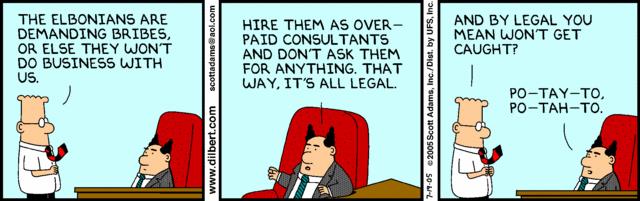
If you do not like that offering, consider this one: Tips express gratitude for a legal service that has been rendered. Bribes are used to receive an illegal service or advantage that should not be rendered or received.
When I put it like this, it seems clear, right? You are probably wondering about some of the gray areas I mentioned, right? Come on, admit you are wondering.
As Torfason points out, the confusion between a tip and a bribe started centuries ago. He points out that in Feudal times payment were made to officials as a way to gain favor and to avoid their homes and belongs from being confiscated or destroyed (above and beyond taxes). At about the same time it became customary for visitors to whom you offered food or shelter to offer a modest payment in exchange for the hospitality.
There is overlap between tipping and bribery in situations where the receiver threatens to withhold service that the give is entitled to. If the building inspector demands a payment to issue a permit even for properly – done work, it’s demand for a bribe, even though it’s a payment for what the inspector doing is supposed to do. If a customs inspector demands a payment to pass equipment through customs, even when everything is in order, it is a demand for a bribe. To me the largest reason these improper payments occur is that there is abuse of power by the person demanding the bribe.
If you check your coat at the Holiday Party, and you see a tip jar, do you feel compelled to put something in it to ensure you get your coat (and all of the contents of the pockets back) at the end of the evening? Or, do you add something only after you get your coat back and check to make sure the contents of the pockets are there?
In business, there are expectations that modest gifts are exchanged at meetings. We have all either faced the situation or heard of the situation, right? What do you do? Do you insult your host and potential business partner by appearing to snub them and show disrespect for their customs and cultural norms? To you feebly try to explain your company’s “Business Practices” policy? Do you attempt to use smaller trinkets and less formal exchanges?
Torfason makes it clear that this can be a dangerous area and a very slippery slope when the line between a tip and a bribe gets blurry.
“Once you start engaging in these informal tit-for-tat exchanges, it may increase your susceptibility to engage in certain acts of informal exchange that may not be acceptable,” said Torfason. “Informal exchanges are trickier to manage than people sometimes think,” Torfason said. “Once you are embedded in a web of informal transactions and favors, it can sometimes become harder to judge what’s appropriate and what’s not.”
There is no simple answer and there is no globally accepted rule. Rely on your training and your good sense. Finally, please keep one eye on the transaction and the other one firmly on your own company’s Business Practices.
Primary Source: Torfason, “Here’s a Tip: Prosocial Gratuities Are Linked to Corruption,” Social Psychological & Personality Science, 2012



I know that this is not exactly within your topic, but I have a question. Do you think that “Tipping” is thought of very differently according to our demographic perspective? Is tipping viewed differently by different generations?
If you mean real tipping to show appreciation for services rendered, yes, there is a lot of variability around the world. Tipping practices, including appropriate amounts, can be easily found for most countries by doing an Internet search. When traveling, it is wise to understand local norms so you do not get an unwanted surprise in your soup or find that things are missing from your suitcases; mostly it is wise so you do not offend your hosts.
In terms of tipping being viewed differently across generations, I think there are differences. Arguably, the older generation is like Morty Seinfeld (from the TV show ) who uses a calculator to get the tip percentage down to the nearest Penny. By contrast, the younger generation thinks a 10% or a 15% tip is too small and suggest 20% is the new 10% minimum. Most folks are somewhere in between.
Steve, let me share a “coincidence” with you. I have taken hundreds and hundreds of airline flights in my life, and the one and only time that my luggage didn’t arrive at my destination with me (I’m lucky, I know!) was the one and only time that I used the curbside check-in service. I was very young and early in my career at the time and did not understand the expectation that those working the curbside check-in were to be “tipped”, so I just handed them my luggage and proceeded into the terminal. I wonder what the fate of my suitcase would have been if I had slipped the attendant a Lincoln??
It’s a separate, but very similar, situation with political contributions. When a large donation is made by an individual or group to a particular candidate, there is often a knee-jerk reaction that influence is being purchased and that the candidate will be compelled to act or vote in a particular way…i.e., a bribe. Perhaps that is because that is sometimes exactly what is happening! However, isn’t is also possible that a contribution is being made to a candidate because the donor considers that that candidate’s position on a single or multiple issues, or even on an overall philosophical level, is better for the donor and/or society than that of the opponent in the race? That would be not only “tipping” the candidate for their established positions but helping to ensure that those positions become relevant. It’s another fuzzy line, and I guess, again, it’s based on the intentions and expectations of the contributor/tipper/briber.
To make it easier on people with wobbly moral compasses, THE MAN had regulated political contributions. Even contributions from true followers who want to help are deemed to be bribes – if they exceed a certain amount. Thus, swarms of tax lawyers and election advisors constantly pour over election and campaign laws looking for loopholes. Influence peddling is much more than a cottage industry these days.
Did your bag ever show up? This is truly a lesson in Leadership : taxes come in all forms and sometimes you have to render onto Ceasar what he is due.